

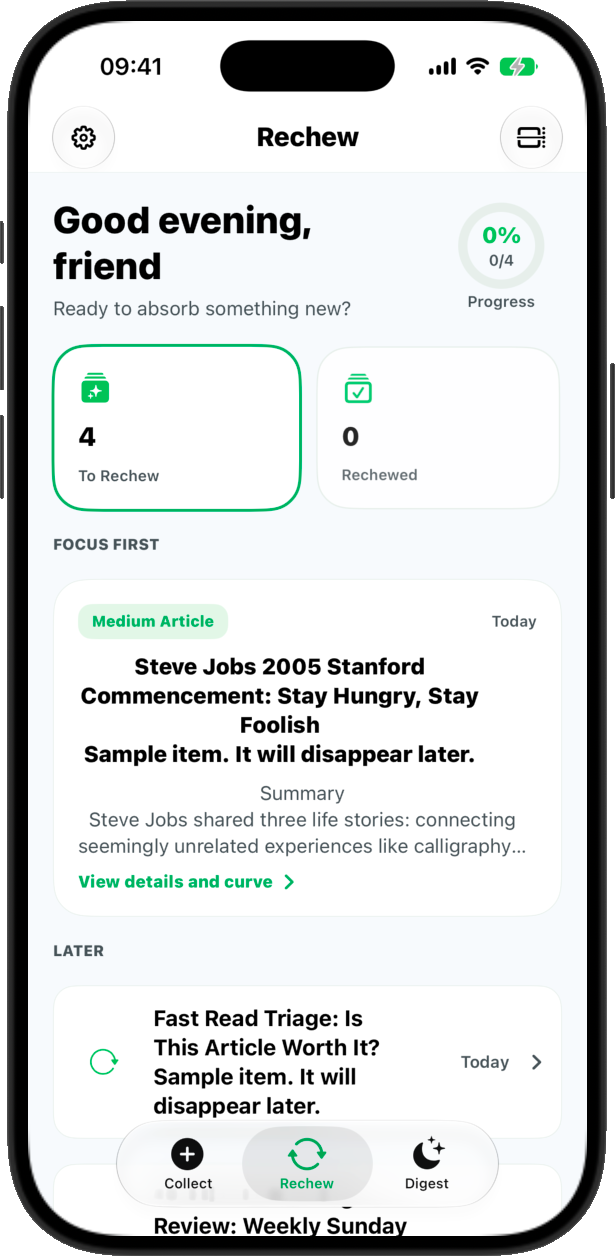
You save the article because it looks useful.
Then another one appears. And another.
A few weeks later, your read-later list is full of thoughtful essays, reports, threads, and ideas you genuinely meant to return to — but probably will not.
That is not a saving problem. It is a revisit problem.
Most read-later apps are good at one thing: helping you postpone reading. But postponing is not the same as learning, and a long backlog is not the same as a knowledge system.
That is where ReChew comes in.
Why saved articles are so hard to revisit
Saving something feels productive because it protects an idea from disappearing. But it also creates an invisible promise: “I will deal with this later.”
For high-information people, later rarely arrives.
New inputs keep coming. Work gets busy. The list gets longer. Eventually, opening your saved articles feels less like an opportunity and more like catching up on debt.
The result is familiar:
- You save more than you revisit.
- You read more than you retain.
- You feel informed, but struggle to recall what actually mattered.
A read-later list should help you keep more
ReChew is built for the step after saving.
Instead of treating a saved link as the end of the workflow, ReChew turns it into something you can digest over time. Save useful content, get into the key ideas faster, then revisit it in lightweight review moments.
The goal is not to build another perfect archive.
It is to help useful information stay available long enough to become part of your thinking.
How ReChew makes revisiting easier
1. Start with the important part
Long articles can be valuable and still be difficult to return to. ReChew uses AI-assisted summaries to lower the barrier to starting again.
You do not need to remember every detail before you reopen something. You just need a clear way back in.
2. Turn “someday” into a review loop
A normal bookmark sits still until you remember to find it.
ReChew brings saved ideas back into a re-chewing loop, so useful content has another chance to be seen, considered, and remembered.
3. Make retention visible
Reading something once can feel like learning it. Often, it is only the beginning.
ReChew’s retention cues help make the process more tangible: you can see that remembering is built through return visits, not guaranteed by one good summary.
3 ways to rescue your saved-article backlog
- Start with the articles you still think about. Do not try to process everything at once.
- Save for a reason. Before saving, ask: “Will this help me make a decision, do my work, or understand something better?”
- Revisit lightly. A short return to a useful idea is more valuable than endlessly collecting new ones.
Ready to make your saved content useful again?
Your read-later list does not need to become another source of guilt.
ReChew helps you clear the backlog, digest what you save, and keep more of the ideas worth returning to.
Save less pressure. Keep more value.