

AI summaries are everywhere now.
A long report becomes five bullets. A podcast becomes a neat transcript. A complicated topic becomes a quick explanation before your next meeting.
That is genuinely useful.
But there is one question worth asking: if an AI summary helps you understand something faster, does it also help you remember it?
Usually, not by itself.
Fast understanding is not the same as lasting retention
A good summary can reduce friction. It can help you identify the main argument, spot the important details, and decide whether something deserves more attention.
But reading a concise answer once does not guarantee that it will still be available when you need it next week.
This is the retention gap:
- You understand something in the moment.
- You feel like you learned it.
- Time passes.
- The useful parts become difficult to recall.
The problem is not that AI summaries are bad. The problem is expecting them to do a different job from the one they were designed for.
AI makes the first pass easier. Retention needs a second pass.
Why summaries can create a false sense of learning
When information is well explained, it feels familiar. Familiarity is useful, but it can be misleading.
You may recognise an idea when you see it again without being able to explain it, apply it, or use it in a decision.
That is why “I read a summary” and “I retained the insight” should not be treated as the same outcome.
The most useful question is not:
Did I finish this quickly?
It is:
Will this still be useful to me later?
What should happen after an AI summary?
A better workflow has three stages.
1. Understand
Use a summary to make the material approachable. Get the context, argument, and key takeaway without turning every saved article into a research project.
2. Revisit
Return to the idea after the first read. A small revisit gives you another opportunity to connect the information to what you already know.
3. Retain
Notice what is actually staying with you. The aim is not perfect recall of every saved item. It is building a more reliable relationship with the information that matters.
How ReChew works after the summary ends
ReChew does use AI-assisted summaries, but that is not the finish line.
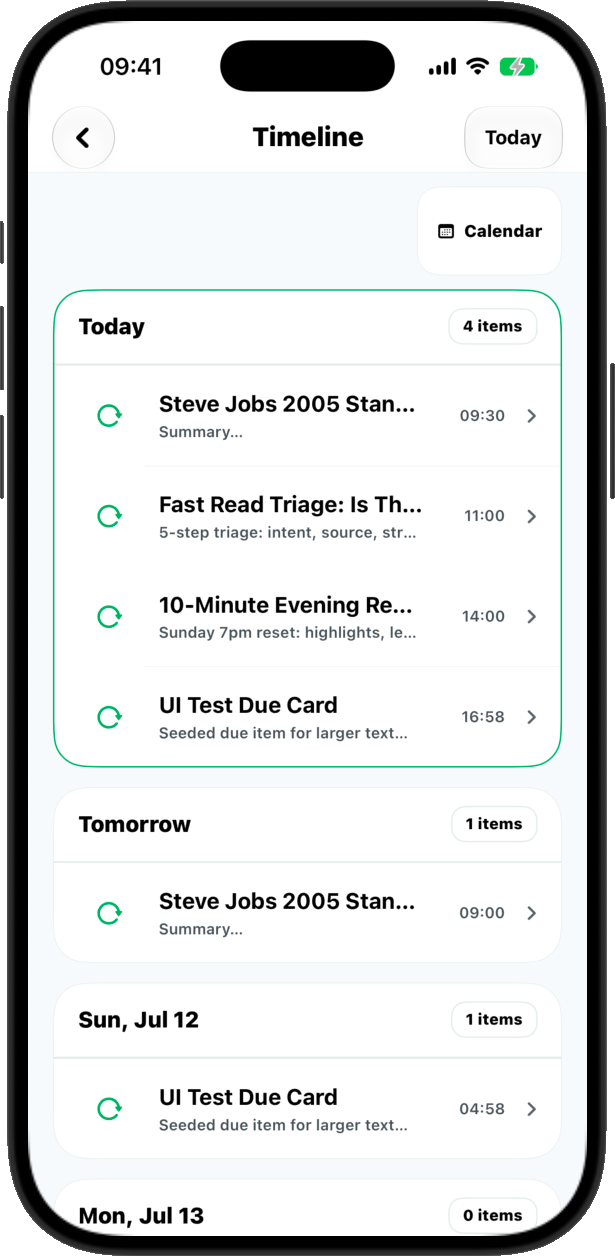
It helps move useful input into a re-chewing and review loop, with visible retention feedback to make the process feel less abstract.
Instead of leaving a summary as a one-time answer, ReChew gives it a path to become something you revisit and gradually keep.
AI gives you speed.
ReChew helps you make that speed worth something later.
Use AI summaries without losing the value
Try this simple rule:
- Use AI summaries to decide what matters.
- Revisit the ideas that affect your work, decisions, or perspective.
- Let go of the rest without guilt.
You do not need to retain everything you consume. You just need a better way to avoid losing the things that matter.
The summary is the entry point. Retention is the product.