

Your read-later list was meant to help you read more.
Instead, it may be making reading harder.
When every saved article feels important, it becomes difficult to choose one. When the list grows faster than you can process it, reading starts to feel like a task you are already behind on.
The answer is not to force yourself through hundreds of tabs.
It is to build a reading habit that has room for real life.
Stop treating every saved article as a commitment
Not every article you saved still deserves your attention.
Maybe it was timely last week. Maybe the headline was interesting but the topic is no longer relevant. Maybe you simply saved it because you did not have time to decide.
That is normal.
A useful read-later list is a working queue, not a permanent archive. Give yourself permission to remove items that no longer matter.
Choose a smaller “now” list
Instead of asking, “How do I finish everything I saved?”, ask:
What are the three things I would be glad to understand better this week?
Pick a small number of articles, reports, or ideas that connect to your current work or genuine curiosity.
A focused list is easier to return to. And returning is more important than building an impressive backlog.
Read for a reason
Before opening an article, give it a job.
You might be reading to:
- Understand a market or trend.
- Prepare for a project decision.
- Learn a new skill.
- Capture one useful idea.
- Stay curious about a topic you care about.
Reading with a purpose makes it easier to decide what is worth keeping — and what can be let go.
Make revisiting part of the habit
A sustainable reading habit is not only about finishing new material. It also includes returning to ideas you want to keep.
That second step is where many reading workflows break down.
You read something useful, save it somewhere, and move on. By the time you need the insight, you only remember that you once saw it.
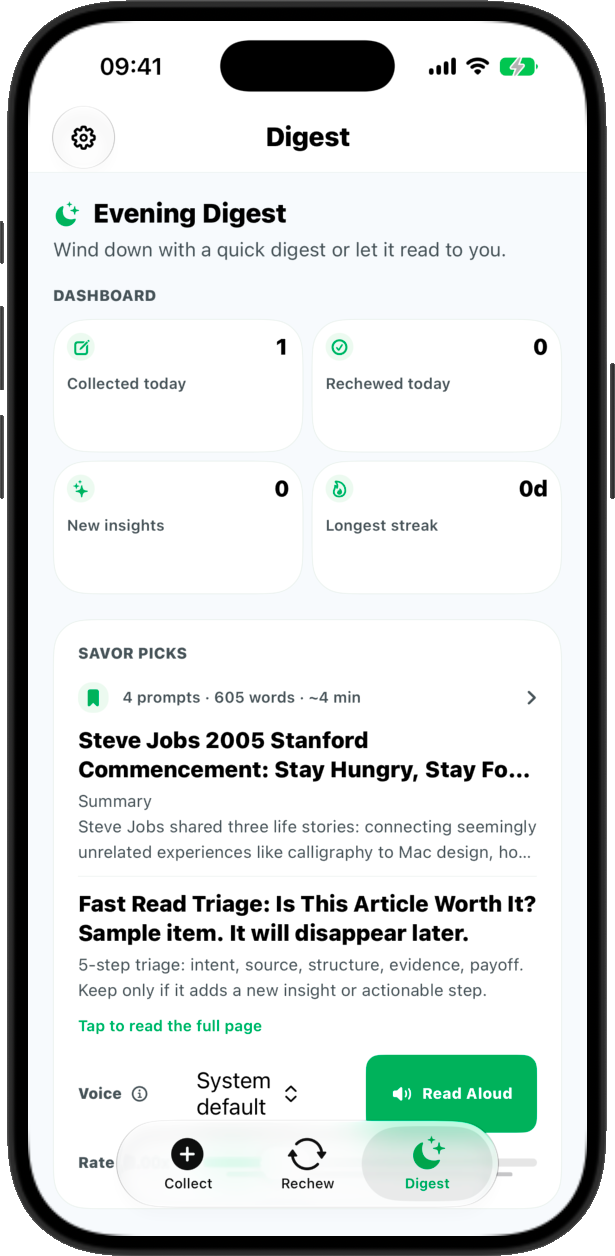
ReChew is designed to close that gap. It helps turn saved content into a lightweight process of digestion, revisit, and retention — without asking you to build a complicated system around every article.
A simple weekly reset for your read-later list
Once a week, spend ten minutes doing this:
- Delete or archive anything that no longer matters.
- Choose up to three items you want to understand this week.
- Save the best ideas into a review flow.
- Let the rest wait without turning into guilt.
The goal is not inbox zero for your reading list.
The goal is to create a smaller set of ideas that actually have a chance to stay with you.
Read less like a collector, more like a learner
There will always be more to read.
The people who get the most from information are not necessarily the ones who consume the most. They are the ones who create enough space to digest, revisit, and use what they find.
ReChew helps make that process lighter.
You do not need more saved content. You need more of it to stick.