

Some days, information seems to pass straight through.
You read, listen, take notes, save links, and even understand the main idea. But by the end of the week, much of it feels out of reach.
When that happens, it is tempting to look for a bigger system: more folders, more tags, more notes, more rules.
Usually, that is not the answer.
If your memory feels overloaded by a high volume of input, the most helpful workflow is often the one that gives important ideas a simple way to return.
Start by reducing the pressure to retain everything
The goal is not to become a perfect archive of everything you consume.
Most input is temporary. Some information is interesting but not useful later. Some is only relevant to one conversation or one task. Letting that material fade is fine.
The valuable question is:
Which ideas would make a difference if I could recall them later?
Those are the ideas worth a second look.
Use a small review loop instead of a large knowledge system
You do not need an elaborate productivity setup to remember more. Start with a loop small enough to repeat.
1. Capture without over-organising
When something useful appears, save it quickly. Do not turn every link into a detailed filing project.
The first job is simply to make sure the idea does not disappear before you can decide whether it matters.
2. Give it a clear reason to stay
Before you move on, identify one reason the item is worth revisiting.
It could be a decision you are making, a project you are researching, or a perspective you want to keep. A clear reason gives the information context when you meet it again.
3. Make returning easy
The revisit should not feel like homework.
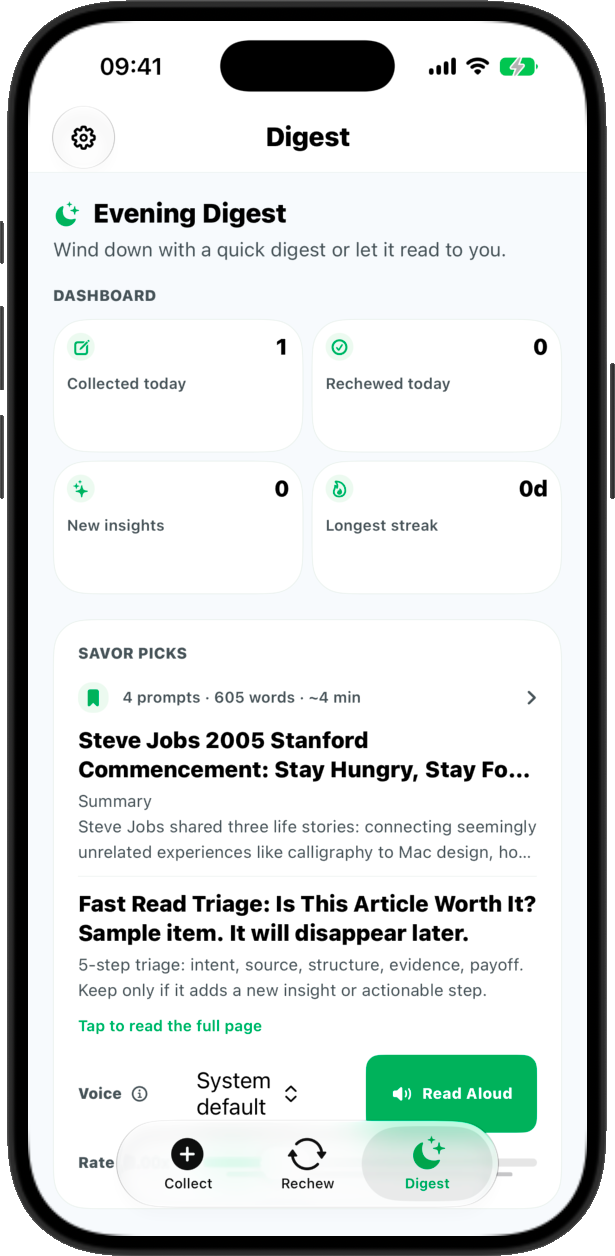
Short summaries, a focused card, or a small daily digest can give you a quick route back into an idea. The aim is not to recreate the entire original reading experience. It is to restore the useful part.
Why visible retention feedback helps
Remembering can feel invisible. You may not notice what is fading until you need it and cannot find it.
Retention cues make that process easier to see. They give you feedback that a useful item has been revisited, instead of leaving it buried in a list and hoping you remember it exists.
This is the principle behind ReChew’s memory curves and re-chewing loops: make the path from input to revisit more visible, without pretending to control memory perfectly.
Build a five-minute habit that fits your day
Try this at the end of a workday or during a calm moment in the morning:
- Open three saved items that still matter.
- Read the summary or key point.
- Keep one idea for later review; let the others go if they no longer matter.
- Stop after five minutes.
The small limit matters. A habit becomes sustainable when it does not demand a rescue mission every time you open your saved content.
ReChew is for the information you want to keep closer
ReChew helps people turn daily input into something they can digest, revisit, and gradually retain. It is designed for high-information days when saving is easy but keeping track of what mattered is hard.
It is not medical advice, treatment, or a tool for diagnosing memory problems. If new or worsening memory difficulties are affecting daily life, speaking with a qualified healthcare professional is the right next step.
For the everyday challenge of useful information slipping away, a lighter review loop can make a meaningful difference.
Read what matters. Return to it gently. Keep more of it close.